


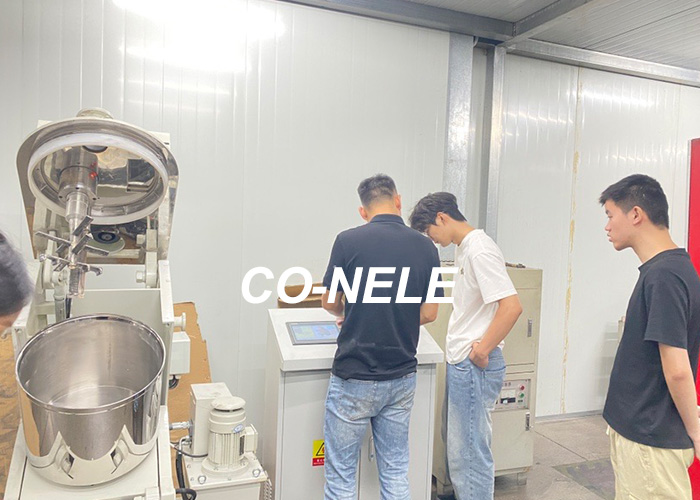
Customer Background
Industry: Oil and gas exploration and development – fracturing proppant (ceramsite sand) manufacturer.
Demand: Develop a new generation of high-strength, low-density, high-conductivity ceramsite proppant formulas and optimize their granulation process parameters. It is necessary to accurately control the mixing, wetting and granulation processes in the pilot stage to obtain stable and repeatable particle precursors (raw balls) to lay the foundation for the subsequent sintering process.
Customer requirements for petroleum proppants
The raw materials (kaolin, alumina powder, binder, pore former, etc.) have large density differences and are easy to stratify, requiring strong and uniform mixing.
The amount and uniformity of the binder solution (usually water or organic solution) have a great influence on the particle strength, particle size distribution and subsequent sintering performance.
It is necessary to form raw balls with high sphericity, narrow particle size distribution (usually in the range of 20/40 mesh, 30/50 mesh, 40/70 mesh, etc.) and moderate strength.
The experimental scale is small, and the equipment accuracy, repeatability and controllability are extremely high.
A variety of formulations and process parameters need to be screened quickly.
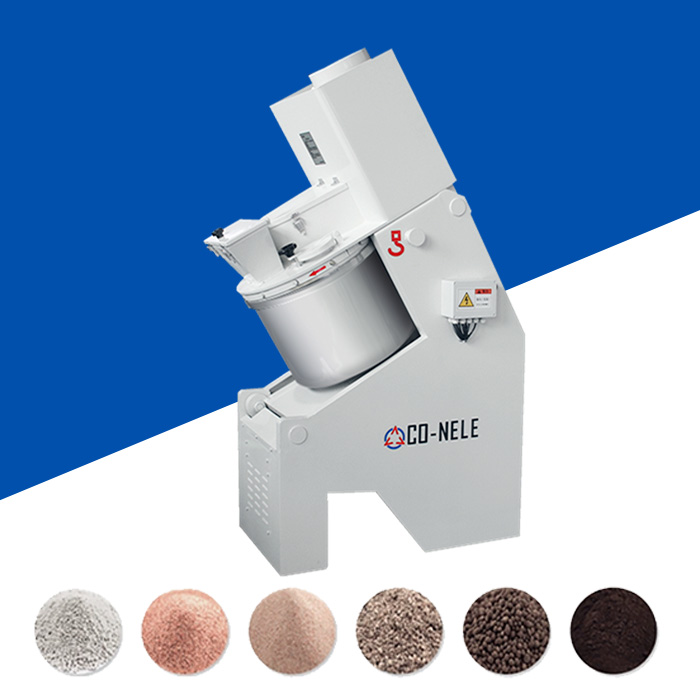
CO-NELE Solution: 10-liter laboratory small mixer granulator (CR02 lab small granulator)
The customer chose a 10-liter laboratory mixer granulator with the following features:
Controllable granulation process: By independently adjusting the rotation speed and time of the granulation disk, the linear speed of the wet mixing and granulation stages can be accurately controlled to affect the compactness and particle size of the particles.
Material: The part in contact with the material is made of 316L stainless steel, which is corrosion-resistant, easy to clean, and meets GMP/GLP requirements (important for laboratory data reliability).
Enclosed design: Reduce dust and solvent volatilization, improve the operating environment, and protect the safety of operators.
Easy to clean: Quick-open design, all parts are easy to disassemble and clean to prevent cross contamination.
Petroleum proppant granulation process
Dry mixing: Put accurately weighed dry powder raw materials such as kaolin, alumina powder, pore-forming agent, etc. into the 10L hopper. Start the low-speed stirring paddle for preliminary mixing (1-3 minutes).
Wet mixing/granulation: Spray the binder solution at a set rate. Start the low-speed granulation disk (to keep the material moving as a whole) and the high-speed granulation disk at the same time. This stage is critical. The growth and compactness of the particles are controlled by adjusting the speed, spray rate and time.
Unloading: The wet particles are unloaded for subsequent drying (fluidized bed drying, oven) and sintering.
Customer evaluation
“This 10L laboratory mixer granulator has become the core equipment of our proppant R&D department. It solves the problems of uneven mixing and uncontrollable granulation in small batch tests, allowing us to accurately “copy” and “predict” the granulation effect of large-scale production on the laboratory bench. Its accuracy and repeatability have greatly accelerated the development of our new products and provided very reliable data support for process amplification. The equipment is intuitive to operate and easy to clean, which greatly improves our work efficiency.”
For companies committed to the development and production of high-performance petroleum proppants, a reliable and precisely controlled 10L laboratory mixer granulator is an indispensable tool to enhance core competitiveness.
Need to know the specific equipment brand model recommendation or more detailed technical parameters? CO-NELE can provide more information.
Post time: Jul-28-2025


