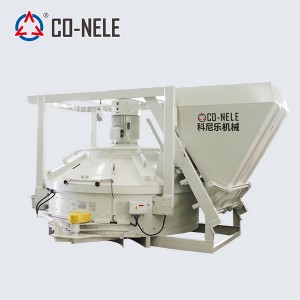
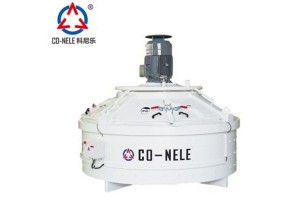
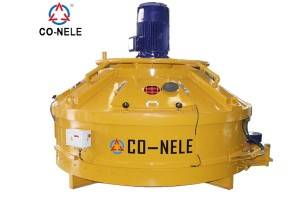
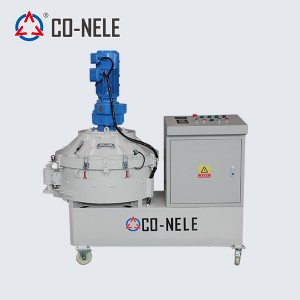
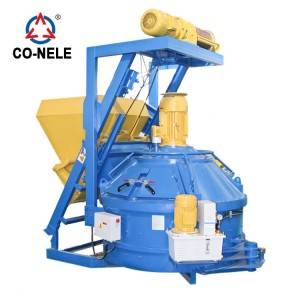
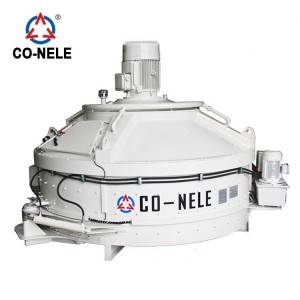
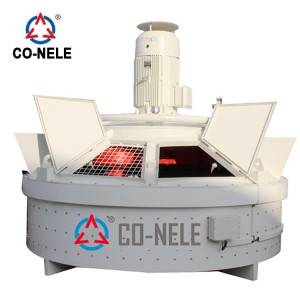
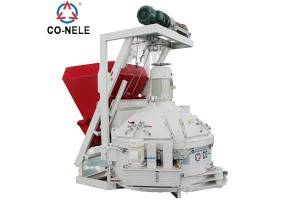
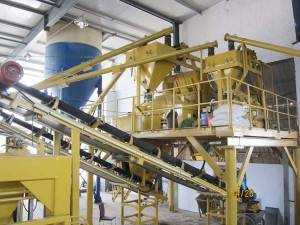
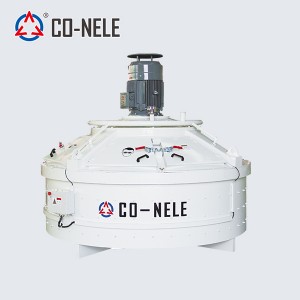
A planetary concrete mixer is a high‑efficiency, advanced mixing device. Its core advantage lies in simulating the orbital motion of planets around the sun. Unlike traditional mixers, the mixing arms of a planetary mixer rotate around the main shaft (revolving) while also spinning on their own axes (rotating), creating a complex and highly effective three‑dimensional mixing motion. This enables the material to be mixed “in all directions without dead corners” inside the mixing drum, significantly improving the uniformity and quality of the concrete. As a leading practitioner in this field, CO‑NELE has successfully applied its planetary mixers to many high‑end applications such as UHPC (ultra‑high performance concrete), precast components, and fibre‑reinforced concrete, accumulating extensive industry experience.
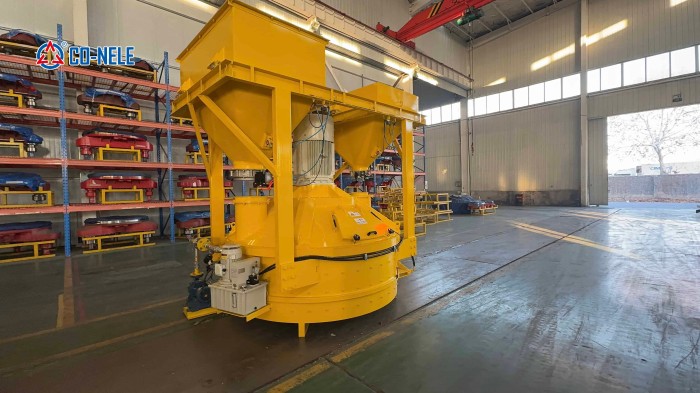
Working Principle: Combined Motion and Mixing Mechanics
The outstanding performance of a planetary concrete mixer comes from its combined rotation and revolution motion mode.
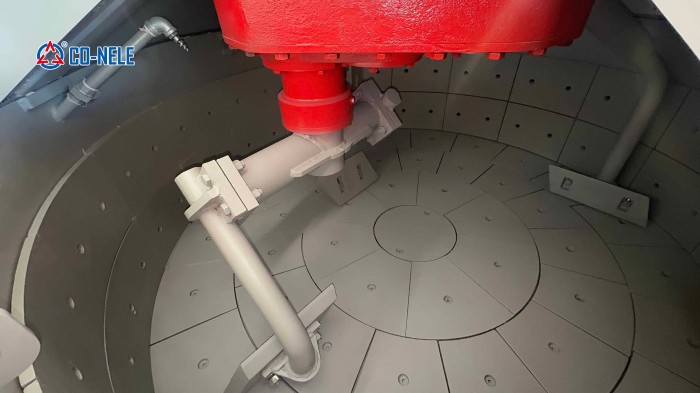
Each mixing arm rotates rapidly around its own axis. This motion mainly generates shear force, effectively breaking up material agglomerates and evenly dispersing additives such as fibres.
The entire mixing system (including all mixing arms and the planetary carrier) rotates around the central axis of the mixing drum. This motion drives the macro‑circulation of all material inside the drum, achieving convection mixing and preventing material sedimentation.
The superposition of these two motions produces a three‑dimensional material flow and a diffusion mixing effect, where particles constantly exchange positions in three dimensions. This combination of rotation + revolution creates three mixing actions – shear, convection and diffusion – ensuring that all raw materials (especially cement, water, aggregates and additives) are fully and evenly mixed in a very short time.
For example, with CO‑NELE’s CMP vertical planetary mixer, the mixing blades completely cover the bottom of the mixing pan every 5 seconds, leaving no dead zones, thus achieving the high homogeneity required for demanding materials.
Core Structure and Motion Path
A typical planetary concrete mixer consists of the following main components:
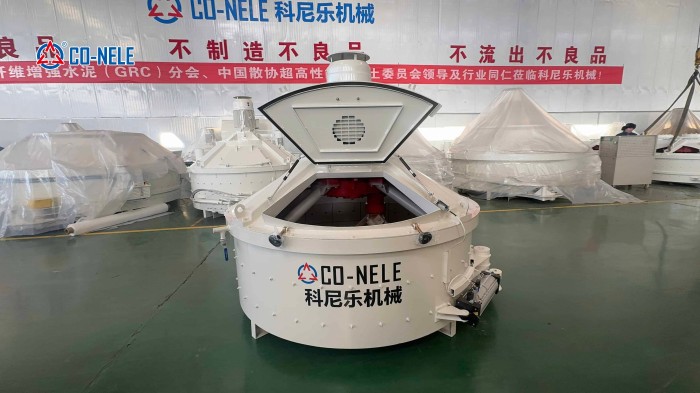
A strong cylindrical container, usually made of high‑strength steel, where the material is mixed.
The “heart” of the equipment, providing power.
The core transmission unit. It efficiently distributes power from the motor to the mixing system to realise the complex planetary motion. CO‑NELE’s drive system uses a hardened‑tooth reducer, characterised by low noise, high torque and strong durability. Its gearbox, which has fully independent intellectual property, incorporates advanced European technology.
Usually located at the bottom of the mixing drum. The discharge door is opened and closed by hydraulic or pneumatic means, allowing fast, residue‑free discharge. CO‑NELE offers a flexible choice of 1‑3 discharge doors, each equipped with a special sealing device to ensure reliable sealing and no leakage.
Imagine a large circular mixing drum with a main shaft in the centre. The main shaft drives a planetary carrier (imagine a rotating “solar system”). Several mixing arms (like “planets”) are arranged on the planetary carrier. When the mixer starts, the planetary carrier slowly revolves around the drum centre, carrying all the mixing arms; at the same time, each mixing arm also rotates rapidly on its own axis. This is like the Earth revolving around the Sun while rotating on its own axis. This complex motion path ensures that the blades sweep every corner of the drum, eliminating mixing dead zones.
Planetary vs. Traditional Mixers
Compared with traditional mixing equipment, planetary concrete mixers offer significant advantages in several aspects.
| Comparison Aspect | Planetary Mixer | Traditional Mixer (e.g. drum mixer) |
|---|---|---|
| Mixing principle | Forced, 3D mixing (shear + convection + diffusion) | Gravity‑based, 2D tumbling mixing |
| Mixing uniformity | Very high, no dead zones | Moderate, prone to dead zones |
| Efficiency & time | Very high, short mixing cycle | Low, long cycle |
| Applicable materials | Wide – suitable for dry‑hard, plastic, fibre‑reinforced concrete and many special mixes | Limited – mainly for plastic concrete |
| Mixing quality | Excellent – can produce high‑performance, high‑strength concrete | Moderate |
| Maintenance cost | Medium‑high, but compact structure with low failure rate | Low |
Main Application Areas
Thanks to their excellent mixing performance, planetary concrete mixers have become key equipment in modern construction engineering and material preparation. The main application scenarios include:
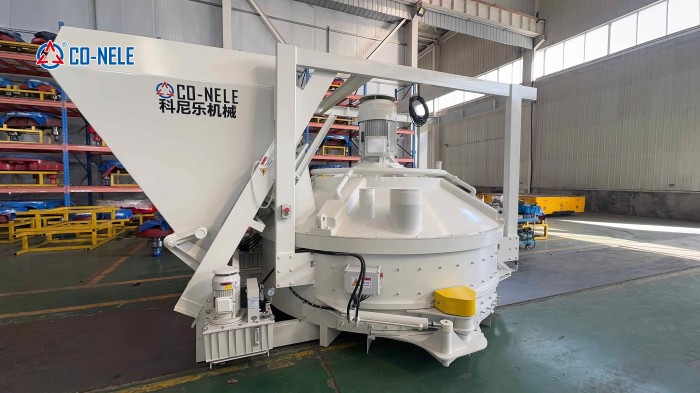
Especially suitable for UHPC, self‑compacting concrete, lightweight concrete and other special concretes that demand high uniformity and high strength. For this field, CO‑NELE has developed the CMPH heavy‑duty planetary mixer, specifically designed for mixing UHPC.
In the production of segmental linings for tunnels, concrete piles, bridge elements, boxes and other precast components, planetary mixers ensure stable concrete quality for each batch, guaranteeing the structural strength of the components. CO‑NELE’s planetary mixers are widely used in production lines for precast wall panels, concrete blocks, paving stones, etc., achieving rapid mixing cycles of 30‑60 seconds and effectively reducing material waste.
In commercial concrete batching plants, they are used to produce various construction concretes in large quantities and with high quality.
They can efficiently mix thermal insulation mortar, self‑levelling mortar, as well as refractory materials, ceramic granules and many other dry or wet building materials. CO‑NELE’s equipment also covers industries such as refractories, chemicals, foundry, metallurgy and glass. Its products have been exported to more than 80 countries and regions, including Germany, the United States, Brazil and South Africa.
Through its unique planetary motion path, the planetary concrete mixer successfully combines the “power” of forced mixing with the “intelligence” of precise motion, representing the future direction of modern mixing technology. Professional manufacturers such as CO‑NELE – with their German‑synchronised technology, over 100 national patents, and a full product range from 50‑litre laboratory units to 6000‑litre industrial mixers – provide global users with high‑performance, high‑reliability planetary mixing solutions. These mixers not only surpass traditional equipment technically, but also provide solid equipment support for the construction industry to move towards higher quality and more sustainable development.
Post time: Apr-14-2026