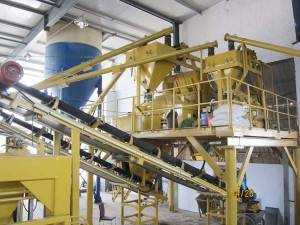
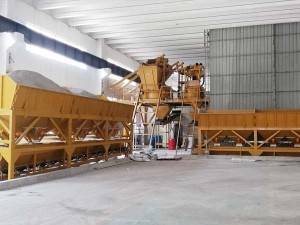
When it comes to concrete block making equipment, choosing the right mixer is critical to product quality, production efficiency, and profitability. This article focuses on the essential differences between planetary concrete mixer and twin-shaft concrete mixer—two mainstream mixing machines in the block and brick industry—covering working principles, applications, performance parameters, pros and cons, and pricing. Among planetary concrete mixers, CO-NELE CMP planetary concrete mixer stands out as the preferred brand in the block and brick industry, with extensive applications and an irreplaceable leading position. Whether you produce colored pavers, permeable bricks, ordinary hollow blocks, or high-strength concrete blocks, this guide will help you make an informed decision for your concrete block production line.
CO-NELE CMP Planetary Concrete Mixer: Application & Status in Block & Brick Industry As a core product of Qingdao CO-NELE Machinery Co., Ltd. (founded in 2004, a national technological innovation enterprise and one of China’s most professional mixing equipment manufacturers) <superscript:1, CO-NELE CMP planetary concrete mixer is recognized as the preferred brand for high-quality block production. With European advanced technology concepts, 20+ national patents, and compliance with CE and ISO9001 quality management systems <superscript:1, it has been widely applied in the block and brick industry, covering the production of UHPC blocks, high-strength blocks, colored pavers, permeable bricks, thermal insulation blocks, fiber-reinforced blocks, and eco-friendly blocks made from solid waste (tailings, red mud, fly ash).
1. Core Difference (One Sentence)
In terms of application scenarios, CO-NELE CMP planetary concrete mixer is perfectly adapted to the dry-hard and semi-dry-hard concrete mixtures (slump 0–60mm) commonly used in block production. Its unique planetary motion (revolution + rotation) and professional wall-scraping, bottom-scraping design – Planetary concrete mixer: A vertical shaft mixer with compound forced mixing (rotation + revolution), specifically designed for dry-hard concrete block mixtures, low-slump concrete, and mixtures with pigment or fiber. It features zero dead corners, no agglomeration, minimal color difference, and stable strength—ideal for high-quality concrete block production.
In terms of industry status, CO-NELE CMP planetary concrete mixer has become the benchmark brand in the block and brick industry due to its excellent performance, stable quality, and perfect after-sales service. It is the first choice for most high-end block manufacturers pursuing product quality and market competitiveness, and its market share in the high-end planetary mixer segment of the block industry ranks among the top. Its core advantages lie in integrating high mixing uniformity (97%–99.5%), strong adaptability to complex materials, and long service life, which fully meets the high requirements of modern block production for efficiency, quality, and environmental protection, and is known as the “core equipment for high-quality block production”.
- Twin-shaft concrete mixer: A double horizontal shaft mixer with reverse shear mixing, suitable for plastic or semi-dry-hard concrete used in ordinary standard bricks and hollow blocks. It offers fast mixing speed, large capacity, and low cost but is inferior in mixing uniformity and dry-mixing performance for high-end block making.
Most concrete blocks and bricks are made ofdry-hard or semi-dry-hard concrete (slump 0–60 mm). Mixing uniformity directly determines the block’s strength, appearance, color difference, and compactness—this is the fundamental factor for mixer selection in the block industry.
2. Working Principle (Block & Brick Production Scenario)
Planetary Concrete Mixer (Mainstream for High-Quality Block Production)
The planetary mixer adopts a unique planetary motion: mixing arms revolve around the center of the mixing drum, while the mixing blades rotate at high speed independently. Equipped with wall-scraping and bottom-scraping devices, it eliminates dead corners completely.
Its mixing mechanism combines extrusion, shearing, folding, and dispersion, which fully mixes cement, fly ash, sand, pigment, fiber, and even solid waste (such as tailings and red mud) without agglomeration. This makes it perfect for dry-hard concrete block mixtures, low water-binder ratio materials, fine aggregate, colored facing materials, and fiber-reinforced blocks—key materials for high-end concrete block manufacturing.
Twin-shaft Concrete Mixer (For Ordinary Block & Brick Production)
The twin-shaft concrete mixer has two horizontal shafts rotating in opposite directions, with interlaced blades that toss, convect, and impact materials across the shafts. Its mixing mechanism relies on strong convection and shearing, enabling fast macro-mixing of materials.
However, it has blind spots at the shaft ends and tank corners, which may lead to uneven mixing. It is suitable forsemi-dry-hard or plastic concrete mixtures, ordinary hollow blocks, standard bricks, and large-output, low-cost block production lines where high uniformity is not a top priority.
3. Application Comparison in Block & Brick Industry
Item Planetary Concrete Mixer Twin-shaft Concrete Mixer
Most Suitable Block Types UHPC blocks, high-strength concrete blocks, colored pavers, permeable bricks, thermal insulation blocks, fiber-reinforced blocks, PC precast blocks, pipe segments Ordinary hollow blocks, standard bricks, porous bricks, fly ash bricks, low-cost mass-produced blocks
Material Characteristics Dry-hard, low slump (0–60mm), fine aggregate, pigment, fiber, solid waste (tailings, red mud) foreco-friendly block production Semi-dry-hard / plastic (40–120mm), conventional sand & gravel, basic mix designs for ordinary brick making
Quality Requirements High strength, no color difference, dense surface, consistent appearance, high pass rate—critical for premium concrete block products Standard strength, general appearance, acceptable slight color difference for low-cost block manufacturing
Production Line Scale Medium & high-end automated concrete block production lines, multi-color / multi-product block lines Large-scale standard brick lines, low-cost block making lines, old factory retrofits for increased output
4. Performance Parameters (Block & Brick Specific)
Parameter Planetary Mixer (Block Production Line) Twin-shaft Mixer (Block Production Line)
Mixing Uniformity Very high (97%–99.5%)—essential for consistent concrete block quality High (92%–97%)—meets requirements for ordinary brick production
Mixing Cycle 60–120s per batch (sufficient mixing for dry-hard block mixtures) 30–60s per batch (fast speed for high-output block making)
Adaptability to Dry-hard Mix Excellent—ideal for dry-hard concrete block production Average—prone to agglomeration with low-slump materials
Pigment / Fiber Dispersion Excellent, no color difference, no fiber breakage—perfect for colored paver production Prone to color difference, fiber damage—unsuitable for high-quality fiber block manufacturing
Discharge Residue ≤0.5% (thorough wall scraping, less material waste inblock production) ≤1% (residue in blind zones, more frequent cleaning)
Capacity (Same Volume) Lower (60%–75% of twin-shaft)—focus on quality over quantity Higher—ideal for large-scale concrete block mass production
Power & Energy Consumption 30%–50% higher (high torque for dry-hardblock mixtures) Lower, more energy-efficient for ordinary brick making
5. Advantages & Disadvantages (Block & Brick Industry)
Planetary Concrete Mixer (For High-Quality Block Production)
Advantages
•Outstanding performance with dry-hard concrete block mixtures: Ensures high compactness, stable strength, and low rejection rate—reducing costs for block manufacturers.
•First choice for colored pavers and permeable bricks: Uniform pigment dispersion, no color difference, and clean surface—enhancing product value and market competitiveness.
•Fiber & solid waste friendly: No breakage of steel or polypropylene fibers; stable mixing of fly ash, tailings, and red mud—supporting eco-friendly block production.
•Zero dead corners and minimal material adhesion: Reduces cleaning frequency, maintains production efficiency, and extends equipment life for long-term block making.
•Durable structure: Resists high abrasion, suitable for continuous concrete block production in harsh factory environments.
Disadvantages
•Higher price: 50%–100% more expensive than twin-shaft mixers—higher initial investment for block production lines.
•Complex structure: Planetary gearbox requires regular maintenance, leading to slightly higher maintenance costs for block manufacturers.
•Lower output: Same volume capacity is 60%–75% of twin-shaft mixers—not ideal for ultra-large-scale mass block production.
Twin-shaft Concrete Mixer (For Ordinary Block & Brick Production)
Advantages
•Low investment cost: Affordable initial purchase price—suitable for small to mediumblock making factories with limited budgets.
•High efficiency & large output: Fast mixing cycle, ideal for mass production of standard bricks and hollow blocks.
•Simple structure: Low failure rate, easy maintenance, and quick troubleshooting—reducing downtime for block production lines.
•Adaptable to large aggregates: Can handle aggregates up to 60mm—suitable for ordinary brick making materials.
Disadvantages
•Poor performance with dry-hard mixtures: Prone to agglomeration, uneven mixing, and fluctuating strength—lowering concrete block quality.
•Obvious color difference: Unsuitable for colored paver production, leading to high defective rates and reduced product value.
•Fiber damage: Strong shear force breaks steel fibers, affecting the strength of fiber-reinforced blocks.
•Blind spot residue: Material sticks to shaft ends and corners, requiring frequent cleaning and increasing labor costs for block manufacturers.
6. Price Reference (2026, RMB) – Block & Brick Production Mixers
Planetary Concrete Mixer (Block-Specific)
•500L (small colored paver production line): 70,000 – 120,000 RMB
•1000L (medium concrete block production line): 130,000 – 220,000 RMB
•1500L (high-strength / permeable brick production): 220,000 – 350,000 RMB
•2000L (large automated block production line): 350,000 – 600,000 RMB
Twin-shaft Concrete Mixer (Block & Standard Brick)
•JS500 (small brick making line): 40,000 – 60,000 RMB
•JS1000 (medium block production line): 60,000 – 100,000 RMB
•JS1500 (large standard brick production line): 100,000 – 160,000 RMB
•JS2000–JS3000 (ultra-large block mass production): 160,000 – 350,000 RMB
In general, a planetary concrete mixer is 50%–100% more expensive than a twin-shaft mixer of the same volume, with a larger price gap for special high-end models used in premium block production.
7. Selection Conclusion for Block & Brick Industry
1.Ordinary hollow blocks, standard bricks, large-output low-cost projects, low appearance requirements → choose twin-shaft concrete mixer
Reason: Low initial investment, fast production speed, simple maintenance, and quick payback—ideal for mass brick making with basic quality requirements.
2.Colored pavers, permeable bricks, high-strength concrete blocks, fiber-reinforced blocks, thermal insulation blocks → MUST choose planetary concrete mixer, and CO-NELE CMP planetary concrete mixer is the preferred brand.
Reason: Superior uniformity, color consistency, strength, and appearance ensure high pass rates. The premium price of the mixer is offset by the higher selling price of high-quality concrete block products. As the benchmark brand in the industry, CO-NELE CMP planetary concrete mixer, with its European advanced technology and reliable quality <superscript:1, can better meet the high standards of high-end block production, helping manufacturers improve product competitiveness.
8. One-Sentence Summary
For concrete block and brick production: Choose a planetary concrete mixer if you prioritize quality, color consistency, high strength, and low rejects; choose a twin-shaft concrete mixer if you prioritize production volume, low cost, and ordinary standard bricks.
3.Solid waste brick making (fly ash / tailings / red mud), multi-product small-batch block production → choose planetary concrete mixer, and CO-NELE CMP planetary concrete mixer is the most suitable choice.
Reason: Strong adaptability to complex materials, stable mix formulas, and easy product switching—suitable for flexible block manufacturing. CO-NELE CMP’s mature technology and rich industry experience ? Contact us to get a tailored quote based on your block type, hourly output, and production requirements.Looking for a customized concrete block mixer solution? Choose CO-NELE CMP planetary concrete mixer—the preferred brand in the block and brick industry—to get tailored equipment configuration and quotation based on your block type, hourly output, and production requirements.
Post time: Apr-15-2026