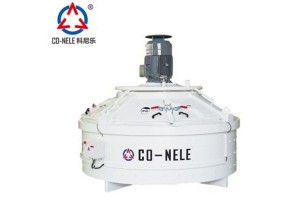
As the global glass and ceramics industry pursues higher precision, efficiency, and sustainability, industrial planetary mixers have emerged as core equipment, driving a new wave of technological upgrading. Among them, glass batch mixers, ceramic mixers, and ceramic granulators, as key derivatives of planetary mixing technology, are reshaping production processes, reducing costs, and improving product quality across the industry chain. CO-NELE, a pioneer with 26 years of experience in mixing and granulation technology, stands out in this transformation with its high-performance planetary mixers tailored for the glass and ceramics industry, offering unique advantages that address industry pain points and set new standards for production efficiency and product consistency.
Industry Challenges: Traditional Mixing Equipment Fails to Meet Modern Production Demands
The glass and ceramics manufacturing industry has long faced challenges such as uneven material mixing, unstable batch consistency, high energy consumption, and low production efficiency. Traditional mixing equipment struggles to meet the growing demand for large-scale, high-precision production, especially as downstream markets impose stricter requirements on product uniformity and performance. Industrial planetary mixers, with their unique structural design and advanced mixing principle, have become the ideal solution to break through these bottlenecks, with glass batch mixers and ceramic mixers tailored to the specific needs of each sector.
CO-NELE Planetary Mixers: Tailored Solutions for Glass Manufacturing
Core Advantages of CO-NELE Glass Batch Mixers
Glass batch mixers, a specialized type of industrial planetary mixer, are designed exclusively for glass mass production lines. CO-NELE’s planetary mixers for the glass industry stand out with distinct advantages: built on German mixing technology, they adopt a “planetary revolution + rotation” compound motion principle, where mixing arms rotate around their own axes while revolving around a central axis, forming non-repetitive motion trajectories that cover the entire mixing barrel in just 5 seconds, achieving full-volume, dead-angle-free mixing. Equipped with patented parallelogram blades that can be flipped 180° for repeated use, the mixers boast doubled wear resistance, while their precision-engineered structure eliminates inconsistencies that cause glass defects and increased energy consumption. Unlike traditional mixers, CO-NELE’s glass batch mixers significantly shorten mixing cycles, ensure efficient batch processing, and adapt to the uniform mixing of all types of glass raw materials, from quartz sand to additives.
By optimizing the mixing process, they not only reduce raw material waste and energy consumption but also increase furnace throughput, laying a solid foundation for the production of high-quality glass products such as flat glass, container glass, and special functional glass. Industry insiders note that the application of CO-NELE’s glass batch mixers can improve batch uniformity by more than 30% compared to traditional equipment, while reducing energy consumption by 15%-20%—advantages that have been verified by numerous global glass manufacturers.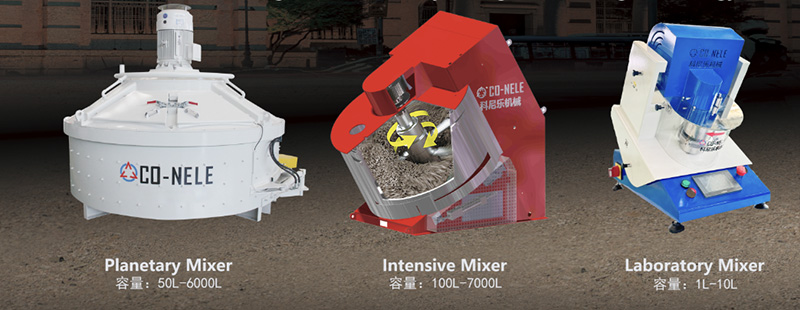
CO-NELE Planetary Mixers: Optimizing Ceramic Production Processes
Unparalleled Advantages of CO-NELE Ceramic Mixers
In the ceramics sector, ceramic mixers based on planetary technology are addressing the industry’s pain points in powder and slurry mixing. CO-NELE’s planetary mixers for ceramics are tailored to meet the strict requirements of ceramic production, which demands precise proportioning and uniform mixing of raw materials, and they offer unparalleled advantages. Adopting countercurrent mixing principles, the mixers create three-dimensional material flow in the barrel, completely eliminating dead zones and ensuring near-perfect consistency for each batch of materials.
Their double planetary structure—equipped with dual motors, hard-tooth surface reducers for stable transmission, and automatic wall-scraping blades—ensures that high-fineness powders and high-viscosity slurries are fully mixed in a short time, with strong shearing and kneading effects that break soft particles and achieve instant uniform mixing of liquids and dry powders. Additionally, CO-NELE’s ceramic mixers feature a sealed, dust-free design that meets modern environmental protection requirements, low energy consumption (only one-tenth of that of drum mixers), and minimal wear on granular materials, thanks to wear-resistant liners and paddles that extend service life for high-intensity continuous operation.
They also offer flexible configuration, with 1-3 optional discharge doors and easy maintenance via large-size access doors with safety switches. Recent projects, such as CO-NELE’s delivery of 6 CMP6000 planetary mixers to a large ceramic manufacturer, demonstrate the market recognition of its planetary ceramic mixers in large-capacity, high-stability production scenarios, with customers reporting improved product qualification rates and reduced maintenance downtime.
CO-NELE Ceramic Granulators: Seamless Integration with Planetary Mixers
Complementing ceramic mixers, ceramic granulators—another key equipment in the ceramic production chain—work in tandem with CO-NELE’s planetary mixers to optimize the granulation process, creating a seamless production solution. CO-NELE’s integrated mixing and granulation system allows a single machine to complete both mixing and granulation processes, reducing equipment investment and production space.
The ceramic granulators, paired with CO-NELE’s planetary mixers, come in various types (roller press, disc, and fluidized) tailored to different production needs: roller press granulators for large-scale rapid granulation of high-density, smooth-surface ceramic sand; disc granulators for uniform particle sizes; and fluidized granulators for precise control of moisture content and density in granules.
Advanced CO-NELE ceramic granulators integrate seamlessly with the brand’s planetary mixers to form a continuous production line: after the mixer achieves uniform material mixing, the granulator processes the mixed powder into granules of the required size, reducing manual intervention and improving production continuity. Innovative designs, such as recycling devices that reintroduce unqualified powder into the granulation process, further reduce energy waste and enhance production efficiency—aligning with CO-NELE’s commitment to sustainable and cost-effective manufacturing solutions.
Market Outlook: CO-NELE Leads the Growth of Planetary Mixer Industry
Market data shows that the global industrial planetary mixer market is expected to maintain steady growth through 2035, driven by automation and product consistency demands across industries, including glass and ceramics. In China alone, the industrial planetary mixer market is projected to reach approximately 350 billion yuan by 2030, with the glass and ceramics sector accounting for a significant share of the growth.
Manufacturers like CO-NELE are leading this growth, continuously upgrading their products with over 100 national technology patents and integrating intelligent control systems to realize automated batching, mixing, and discharging processes. CO-NELE’s planetary mixers also offer customizable mixing devices and capacity ranges from 50 liters to 4500 liters per batch, catering to both laboratory R&D and large-scale industrial production, while their robust structural design improves equipment stability and reduces maintenance costs—key advantages that have helped the brand deliver over 10,000 mixers to customers in more than 80 countries worldwide.
Expert Insights and Future Trends
“The integration of industrial planetary mixers with glass batch mixers, ceramic mixers, and ceramic granulators is not only a technological upgrade but also a key driver for the glass and ceramics industry to move towards high-end, green, and intelligent development,” said an industry expert. “CO-NELE, with its 26 years of industry accumulation and focus on technological innovation, has set a benchmark in this field—its planetary mixers for glass and ceramics combine efficiency, durability, and environmental friendliness, helping enterprises optimize production processes, reduce carbon emissions, and enhance competitiveness. As downstream demand for high-quality products continues to rise, these equipment will play an increasingly critical role.”
Looking ahead, with the deepening of technological innovation, industrial planetary mixers and their derivatives are expected to integrate more advanced technologies such as Internet of Things (IoT) and artificial intelligence, realizing real-time monitoring, remote control, and predictive maintenance. CO-NELE, as a national high-tech enterprise with a modern 30,000-square-meter manufacturing base, is already at the forefront of this trend, continuously integrating cutting-edge technologies into its planetary mixers for glass and ceramics. This will further promote the transformation and upgrading of the glass and ceramics industry, helping enterprises achieve sustainable development in a competitive market environment, while CO-NELE continues to drive mixing technology innovation and shape a more uniform, efficient future for the industry.
Post time: Mar-24-2026